
Centerville, OH · Garage Door Service
What That Garage Door Noise Is Actually Telling You
Centerville homes built mostly 1960s-70s have specific noise patterns tied to original hardware and cold-climate stress. Here's what each sound means and what to check first.
- Repairs & new doors
- Springs & openers
- Serving 7 nearby communities
What Is Going On
Most of Centerville's housing stock went up between 1938 and 2004, with the median build year sitting at 1973 and the bulk of it concentrated in 1960s-70s construction across the area's named neighborhoods. That matters for noise because a door built or installed in that window is old enough that its original torsion spring, rollers, and hinges have likely never been swapped. A door that age doesn't fail quietly - it tells you before it tells your wallet.
A grinding or screeching sound usually means metal-on-metal contact where a roller bearing has dried out or worn through its nylon coating, common on doors from that 1960s-70s run that still carry their factory hardware. A loud bang followed by the door refusing to move is almost always a torsion spring letting go, which on a door this old is not a surprise - it's closer to overdue. A rhythmic thump as the door travels is often a bent track section or a panel that's worked loose at the hinge, both of which show up more on older steel doors that have taken forty-plus winters of expansion and contraction.
The point isn't to diagnose over the phone. It's to know which noises mean "tighten a bolt" and which mean "stop opening it."
What to Check
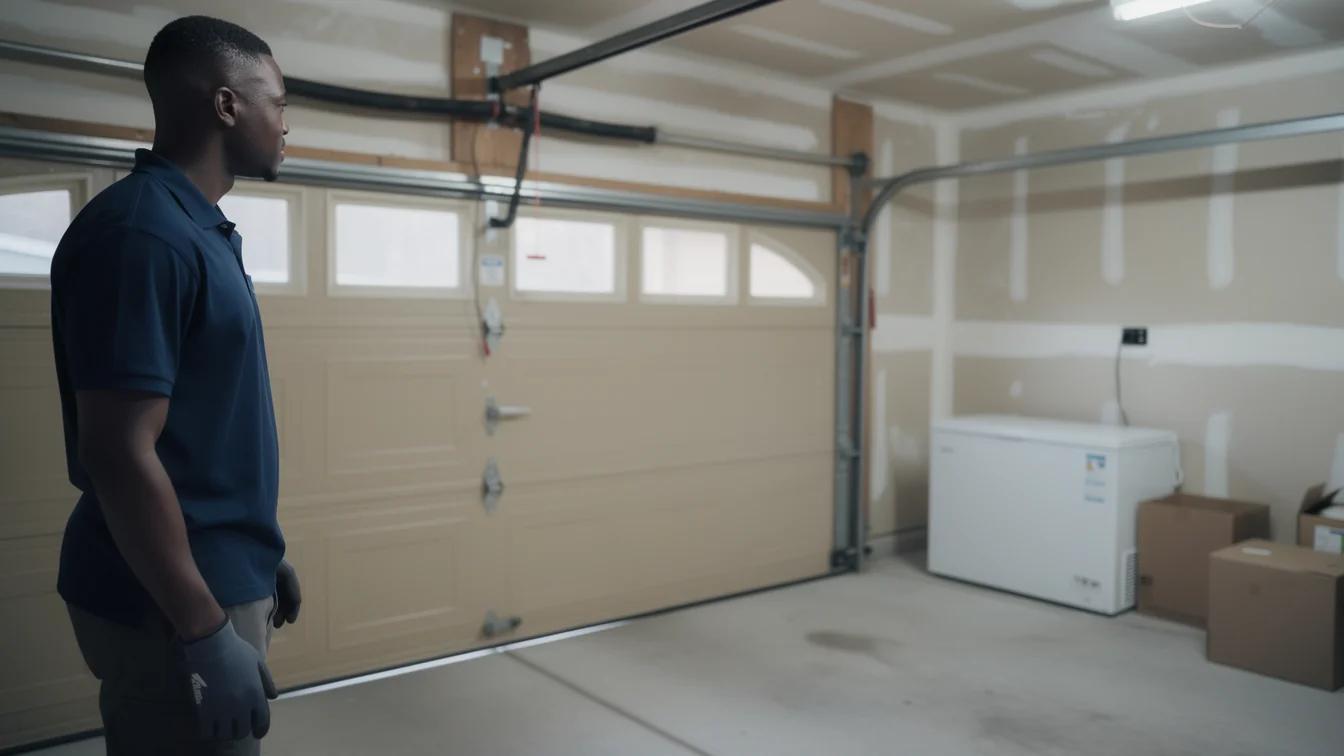
Start with the tracks. Stand where you can see both sides and run the door through one open-close cycle, watching for a roller that jumps the track or a visible gap between the track and the wall bracket - loose lag screws are common on houses built before the newer anchoring standards. Next, look at the spring itself: on a torsion spring above the door, a visible gap in the coil or rust concentrated at one point on the coil means it's close to done, not just loud.
Check the hinges between panels for elongated screw holes, which happen gradually on doors old enough to have gone through decades of seasonal cycling - exactly the kind of door common across Centerville's older sections. If the noise happens only when it's cold, pay attention to whether it quiets down once the door's been run a few times; that's a lubrication and hardware-tolerance issue, not necessarily a failure.
What you should not check yourself: the spring under tension. A torsion spring holds enough stored force to cause a serious injury if it releases while you're working on it. If the bang you heard was the spring, leave the door closed and call - this is the one job on a garage door that isn't a DIY afternoon, regardless of how handy you are.
What It Costs
We're not going to put a number here that doesn't hold up once a tech is standing in your driveway, because what drives the bill is what's actually failed - a dried-out roller is a different job than a snapped spring, and a bent track is different again. What we can tell you is what tends to drive cost up on houses in this area specifically: original hardware from the 1960s-70s building era is often sized differently than what's stocked today, so a repair on an untouched original door sometimes means sourcing a part rather than grabbing one off the truck.
The honest limitation: if a door has reached the point where the track, rollers, and spring are all original and all worn, patching one piece often just shifts the noise somewhere else within a season. At that point, full hardware replacement costs less over time than repeat service calls, even though the upfront number is bigger. We'll tell you straight which situation you're in before we start work, not after.
How Local Conditions Play In
Centerville sits in a severe cold climate band, and that changes how a garage door ages even before you factor in how old the door itself is. Steel contracts in cold weather, which tightens tolerances on tracks and hinges that were already loose from decades of use - this is why a door that's fine in July can start grinding or binding in January. Grease that was fine at 70 degrees can stiffen enough at 20 degrees to slow a roller's travel, and that slowdown is what you hear as a groan or a stutter rather than a clean roll.
This combination - 1960s-70s hardware plus a real winter - is why noise complaints in this area cluster in the cold months even when the underlying wear has been building all year. A spring that's been losing tension gradually will often pick the coldest week to finally let go, because cold steel has less give in it. If your door has been quiet all summer and started talking to you in the first hard cold spell, that's not a coincidence - that's the age of the hardware meeting the season.
Frequently asked questions
My garage door only makes noise when it's cold out. Is that normal?
It's common on older hardware, not something to ignore. Cold steel contracts and grease stiffens, which tightens tolerances that are already loose from age. If the noise is new this winter and the door is original to a 1960s-70s build, the cold is exposing wear that's been building for years, not causing it.
Is a loud bang always the spring?
Not always, but it's the most common cause, especially on a door with original hardware. A bang followed by the door refusing to open or closing unevenly is almost always a torsion spring. Don't try to open it manually - call and leave the door as is until someone can check the spring under safe conditions.
Can I just lubricate the noisy parts myself?
You can lubricate rollers and hinges safely - that's routine maintenance, not a repair. What you shouldn't touch is anything under spring tension or a track that's visibly pulled away from its bracket. If lubrication doesn't quiet it within a cycle or two, the noise is coming from wear, not dryness.
Related garage door services in Centerville
More garage door guides
Book garage door service in Centerville
Call now or request a quote - tell us what the door is doing and where you are.