
Centerville, OH · Garage Door Service
When to Repair and When to Replace a Centerville Garage Door
A look at when an older Centerville garage door is worth repairing, based on the town's housing age, cold winters, and what original hardware actually holds up.
- Repairs & new doors
- Springs & openers
- Serving 7 nearby communities
What Is Going On
Most of the housing in and around Centerville went up between 1938 and 2004, with a median build year of 1973, and the bulk of it clusters in that 1960s-70s wave across the roughly two dozen named areas that make up this part of the county. That matters for garage doors because a door and its hardware don't get swapped out on a schedule. A lot of what we find on service calls is original to the house, or close to it: steel sectional doors on extension or torsion springs, galvanized track bent to fit a header that was framed fifty years ago, and openers that are a later retrofit bolted onto older track.
The question we get isn't usually "is my door broken" - it's "is it worth fixing." For a door from that 1960s-70s run, the honest answer depends on what's actually failed versus what's just old. A torsion spring that snapped on a door with sound panels and track is almost always worth fixing. A door where the bottom panel has rusted through and the track is bent from a car backing into it is a different conversation. We'll tell you which one you have before we tell you what it costs.
What to Check
Start with the springs. On a door from the era most Centerville garages were built, you'll usually find a single torsion spring over the opening or two side-mounted extension springs. If the spring is rusted, gapped, or already stretched unevenly, it's near the end regardless of whether it's currently broken. Next, check the track for rust at the bottom brackets - that's the spot where decades of condensation and road salt tracked in on tires do the most damage, especially on a door that's never been insulated.
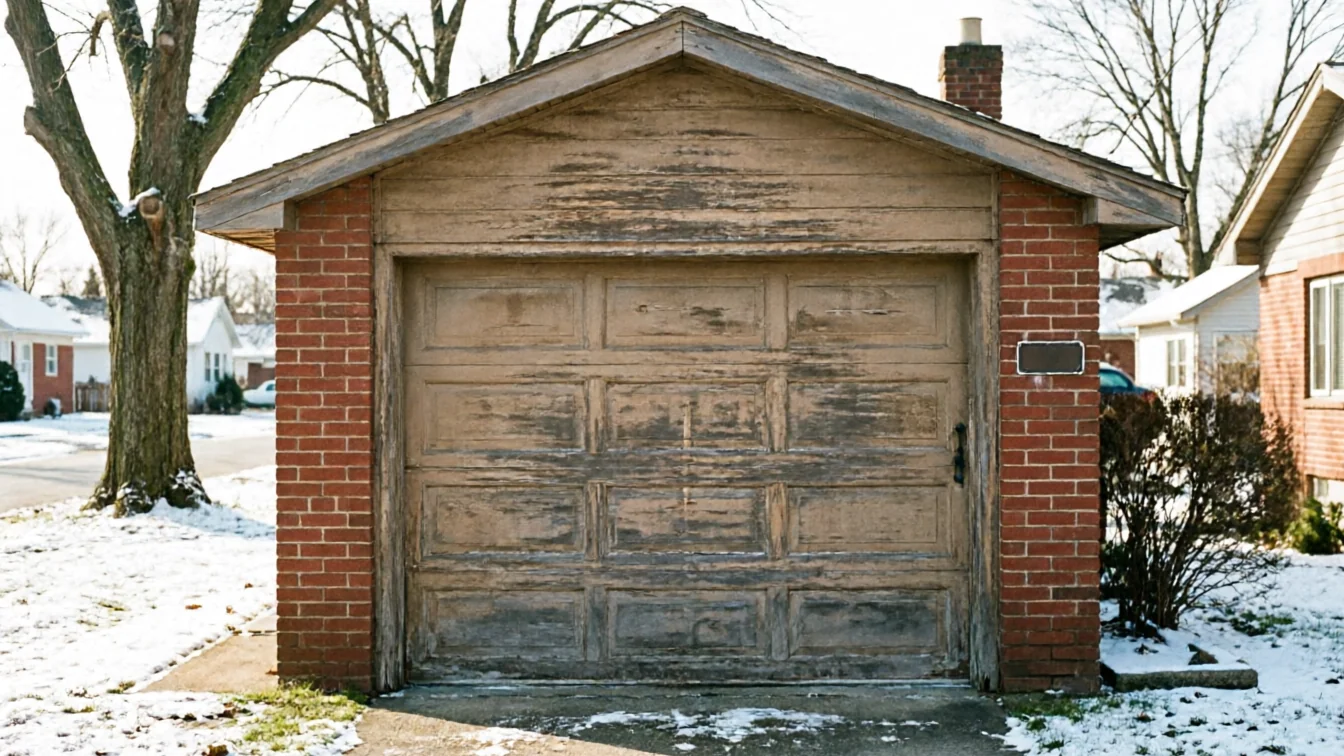
Look at the panels themselves. Steel sectional doors from the 1960s and 70s were often single-layer, uninsulated steel, and surface rust on the bottom two panels is common. Surface rust is cosmetic; rust that's eaten through the steel is not, and it means the panel won't hold a hinge screw much longer. Check the weatherstripping at the bottom and sides - original vinyl from that period is almost always brittle or missing by now, and that's a cheap fix that's worth doing before anything else.
Last, check the opener if there is one. A retrofit opener bolted onto original track is common here, and sometimes the opener is newer than the door by thirty years. Don't assume a door problem is a spring problem until you've ruled out the opener's travel limits and safety sensors.
What It Costs
We don't post a price list here, because what a repair runs depends on what's actually wrong once we're standing in front of the door - spring size, whether the track needs replacing along with it, whether the opener is original or newer. What we can tell you is how to think about the repair-versus-replace line. A broken spring, bad rollers, or shot weatherstripping on a door with straight track and solid panels is a repair, and usually a same-visit one. A door with multiple rusted-through panels, bent track from an impact, or an opener that's failing alongside the door itself is usually cheaper to replace outright than to patch piece by piece.
One honest limitation: we can't give you an accurate number over the phone for a door we haven't seen. Two doors that look the same from the driveway can have completely different hardware underneath, especially on houses built across the range Centerville spans - a 1940s door and a 1990s door built to look similar can need entirely different parts. We quote after we've looked at the spring, the track, and the panel condition, not before.
How Local Conditions Play In
Centerville sits in a severe cold climate band, which means the steel track on a decades-old door spends every winter contracting and expanding, and that cycle is what eventually cracks old welds and loosens bracket bolts that haven't been checked in years. Cold also stiffens torsion springs and grease alike, which is why a door that worked fine in October can bind or refuse to lift fully once temperatures drop - it's not that the door is suddenly worse, it's that the slack in old hardware finally shows up under load.
Across the service area, Census data puts owner-occupied houses at 46,461 out of 86,526 households, which tells you how many garages are running original hardware built for a different climate expectation than what we build to now. A door installed when Centerville's housing was new, back around 1973, is now at or past the age where springs fatigue and seals fail regardless of use. Bellbrook is three miles out, and Oakwood and Five Points are six, so a lot of our calls are doors built to that same mid-century spec, not a quirk of one street or one house. None of that means replace automatically - it means check the hardware before the cold finishes the job the age already started.
Frequently asked questions
How do I know if my spring is original to the house?
If the house was built in the 1960s or 70s like most of this area, and the spring has never been replaced, it's likely original or close to it. Rust, uneven coil spacing, and a dull, worn-looking coat on the metal are signs it's that old. We can confirm on site by checking the wind and gauge against what we carry.
Is it ever worth replacing just the track and keeping the door?
Sometimes. If the panels are sound and the track is bent from an isolated impact rather than general rust, replacing just the track and hardware can make sense. If the track damage comes with rusted brackets or a door that's already racking, it's usually part of a bigger problem.
Why does my older door get harder to open in winter?
Cold stiffens the grease in the springs and rollers and shrinks the steel track slightly, which tightens tolerances that were already loose from age. A door that's marginal in fall often fails outright in a cold stretch - it's the age of the hardware meeting the season, not a new problem.
Related garage door services in Centerville
More garage door guides
Book garage door service in Centerville
Call now or request a quote - tell us what the door is doing and where you are.