
Centerville, OH · Garage Door Service
When the Power Goes Out, Your Opener Goes With It
Centerville's 1960s-70s housing stock and severe cold winters mean openers fail differently here. What to check before you call, and what drives the cost.
- Repairs & new doors
- Springs & openers
- Serving 7 nearby communities
What Is Going On
Centerville's housing stock runs from 1938 to 2004, with the median build year sitting at 1973 and most of the 27 named areas in this service territory dominated by 1960s and 70s construction. That matters for openers because a house wired in 1971 was never built with a dedicated, grounded circuit for a garage door motor. Many of these garages still run on a shared circuit pulled from a kitchen or laundry line, which means a storm-driven outage, a tripped breaker, or a brownout doesn't just stop the opener - it can scramble the logic board's memory of where the door's limits are set.
When power comes back, the opener often doesn't know up from down. It'll grind, reverse unexpectedly, or stop short of the floor. On older chain-drive units common in this housing era, the power loss can also leave the trolley disengaged from the carriage, so the door looks "stuck" when really the opener has just unhooked itself. None of this means the opener is dead. It usually means it needs to be re-taught its travel limits, and on a 1970s-era unit that might mean manually finding the reset procedure since the original manual is long gone.
What to Check
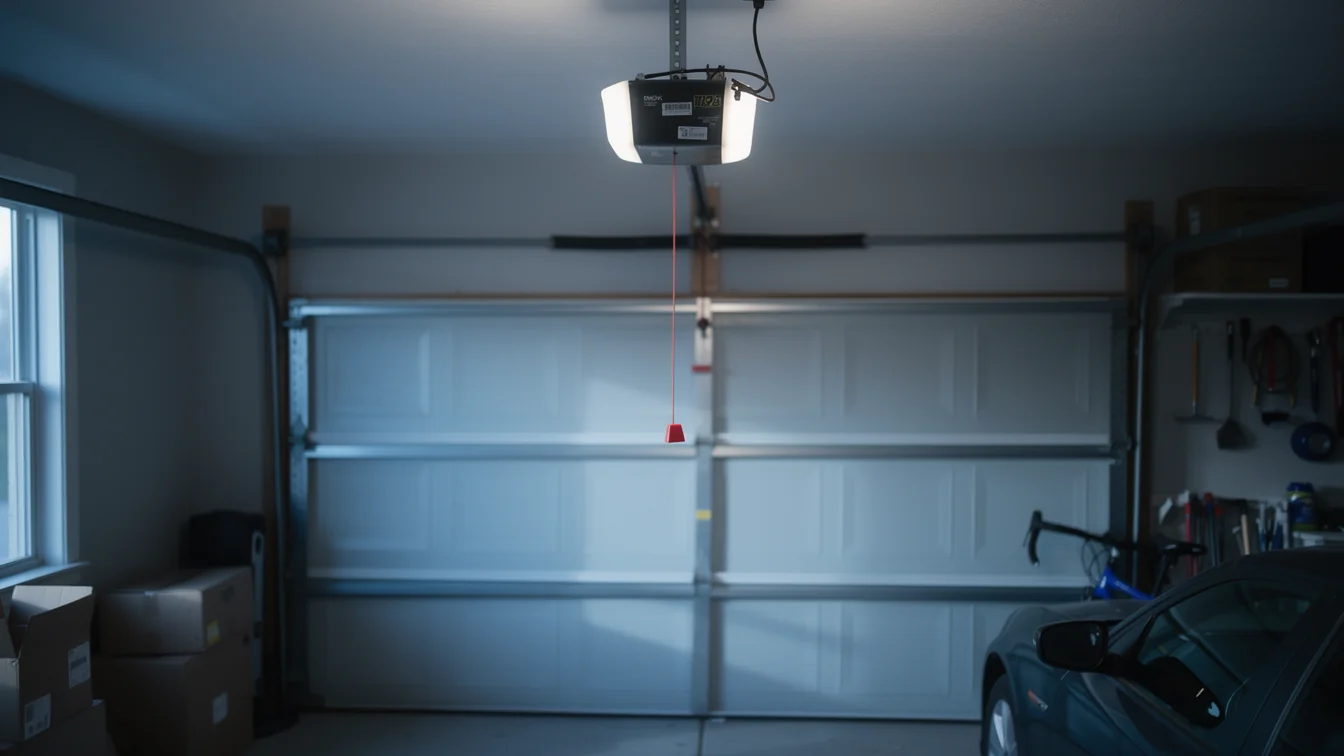
First, pull the manual release cord and see if the door moves freely by hand. If it does, the spring and track are fine and this is an opener-logic problem, not a hardware one. Second, check whether the wall unit has power at all - a tripped GFCI or breaker on a shared circuit is common in houses from the 1960s-70s stock that make up most of this area, and it's a five-minute fix with no parts involved. Third, look at the opener's indicator lights, if it has any; a rapid blink pattern usually means it's in a fault state from the sudden power loss, not a mechanical failure.
If you have a battery backup unit, check whether the battery held charge through the outage. Cold weather is hard on these batteries - in a climate with severe cold winters like this one, a battery backup that tested fine in September can be down to half capacity by January. That's not a defect, it's chemistry, and it's worth testing seasonally rather than assuming it'll perform when you need it.
What It Costs
We don't post flat prices here because the fix depends entirely on what the outage actually damaged. A logic board that just needs its travel limits reset is a short visit. A board that got fried by a power surge during the outage - which happens more in houses still wired to original 1960s-70s panels - is a different job and a different bill. If your opener predates the house's last electrical update, we'll tell you that up front rather than replace a board that's going to get hit again by the next surge.
One honest limit: if the opener is original to a house built in the earlier end of that 1938-2004 range, parts for it may simply not exist anymore. At that point repair isn't the right call, and we'll say so instead of charging you for a part we can't actually source.
How Local Conditions Play In
This area sits in a severe cold climate band, and cold is what turns a routine power blip into a real problem. Lubricant in an old chain-drive opener thickens in the cold, so the motor already has to work harder before you add a power interruption on top of it. That combination - old hardware plus cold-stiffened mechanicals plus a power event - is what actually breaks gears inside the opener housing, not the outage by itself.
Across the wider service area, 46,461 of the 86,526 households are owner-occupied houses, and most of them sit on that same 1960s-70s wiring and opener vintage. Whether you're near Bellbrook three miles out or further toward Springboro or Miamisburg, the pattern repeats: older opener, shared circuit, winter outage, scrambled logic. It's less about where you are and more about when the house and the opener were built - and in this area, that's usually the same decade.
Frequently asked questions
My opener won't move at all after the power came back. Is it broken?
Not necessarily. Pull the manual release cord first - if the door moves freely by hand, the track and spring are fine. The opener likely just lost its travel-limit memory in the outage and needs to be re-taught, which is common on older units in this area's 1960s-70s housing stock.
Why does my battery backup die every winter?
Cold weather reduces battery capacity, and this area sits in a severe cold climate band. A backup battery that tests fine in warm months can be running well under capacity by midwinter. It's worth testing it each fall rather than assuming it'll hold through a storm.
Should I just replace an opener that keeps acting up after outages?
If the opener is original to an older house in the 1938-2004 build range, parts can be hard to source, and repeated board failures from power surges often point to replacement being the better call. We'll tell you plainly if that's the case rather than keep patching a board that'll fail again.
Related garage door services in Centerville
More garage door guides
Book garage door service in Centerville
Call now or request a quote - tell us what the door is doing and where you are.