
Centerville, OH · Garage Door Service
What Actually Happens During a Service Call
A real look at what happens when Centerville Garage Door Pros comes out: what we check, what it costs to find out, and why 1960s-70s builds change the job.
- Repairs & new doors
- Springs & openers
- Serving 7 nearby communities
What Is Going On
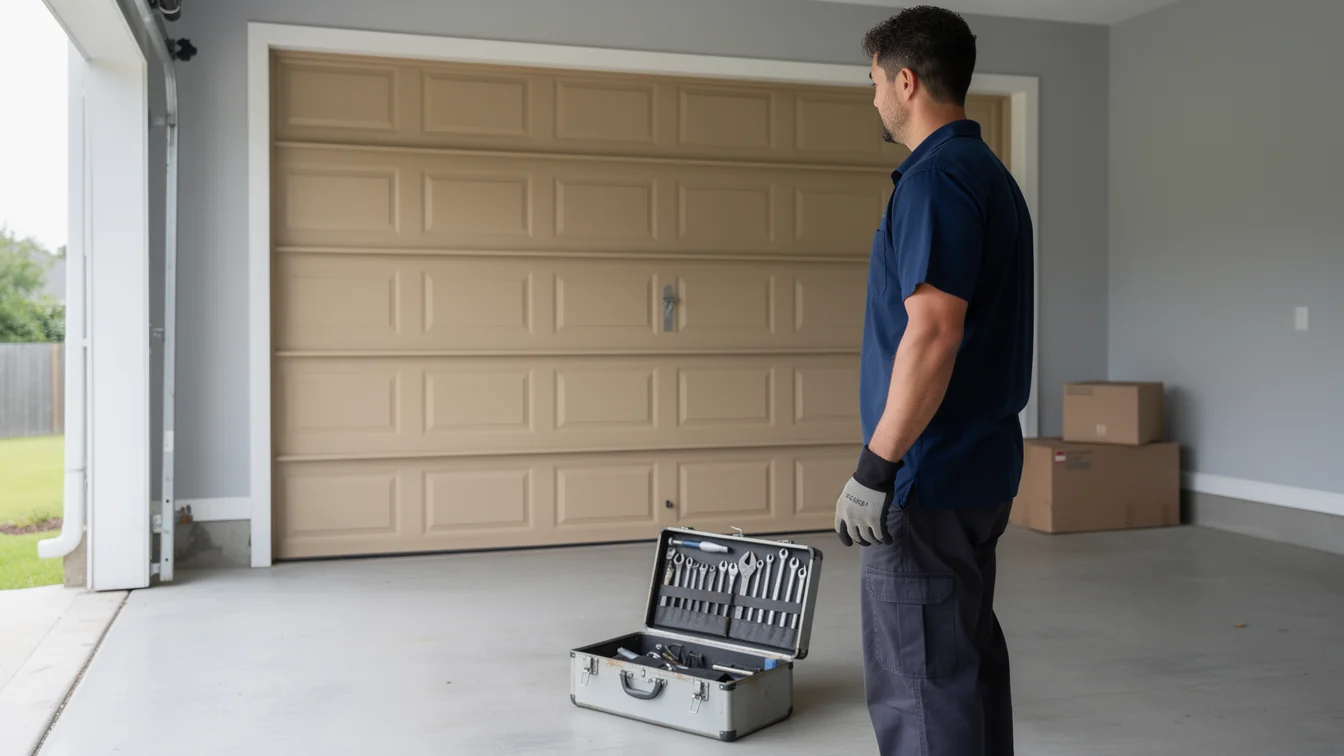
When you call us out, we're not guessing at what's wrong before we see the door. We're walking into a house that, odds are, was built somewhere between 1938 and 2004, with the median landing right around 1973. That one fact shapes most of what we find. A door from that era was likely replaced at least once since, but the opener, the track, or the spring setup often wasn't touched at the same time. We see a lot of mismatched systems: a newer opener bolted to an old track, or a torsion spring sized for a lighter door after a panel swap. The call itself is us tracing the whole system - door, spring, cable, track, opener, safety sensors - to find the one part that's actually failed instead of replacing everything on a guess. Across the 27 named areas we cover, the housing mix is similar enough that we see the same handful of failure patterns over and over. That's useful for us, but it doesn't mean your door gets a generic fix. It means we know where to look first.
What to Check
Before you call, there are a few things worth looking at yourself. Stand the door up and look at the springs above the track - if one side looks stretched or gapped compared to the other, that's a tension problem, not a lubrication problem. Listen for grinding when the opener runs; that's usually rollers, not the motor. Pull the manual release and try lifting the door by hand - if it feels like dead weight instead of lifting with some resistance, the spring is likely done, not just weak. On houses from the 1960s and 70s stock that makes up most of what we service, the original torsion hardware was often sized for a lighter wood door, so if panels were ever swapped to steel or insulated steel, the spring tension may never have been corrected. That mismatch is one of the most common things we find, and it's not something you can fix by eye - it needs a scale or a trained read on the lift. If the door won't budge by hand at all, stop. That's a loaded spring, and it's not a DIY moment.
What It Costs
We don't quote a number sight unseen, and we won't pretend that's a dodge - a broken cable is a different job than a stripped gear in an opener, and the only honest way to price it is to look at the door. What we can tell you is how people in this area tend to decide. With median household income here at $78,598, most of the calls we run end with an owner weighing a targeted repair against letting the whole system go and replacing it, rather than assuming either option is automatically off the table. Age plays into that math. A door and opener original to a house built near 1973 is well past the point where parts are getting easier to find, so sometimes the repair costs real money just to buy a few more years on hardware that's already fighting its age. We'll tell you straight when a repair is the better call and when it's just delaying a replacement you're going to need anyway. That's the one limitation worth saying out loud: we can diagnose the door in front of us, but we can't promise every part on an older system is still stocked the way it was when the house was new.
How Local Conditions Play In
We work in a climate rated cold and severe, and that changes how a garage door ages here compared to a milder region. Steel contracts in low temperatures, which tightens tolerances on tracks and can make a marginal roller or a slightly bent panel suddenly bind in January when it rolled fine in July. Torsion springs also lose a measurable amount of lift capacity as temperatures drop, so a spring that's been weakening quietly for years often picks winter to finally let go. That timing isn't bad luck, it's physics, and it's consistent across the 86,526 households and 46,461 owner-occupied houses in our service area. Houses built in the 1960s and 70s, which is most of what we see, often have single-skin steel doors without much insulation, so the door itself does little to buffer the hardware from outside temperature swings. If your door has started sticking, groaning, or hesitating only in cold weather, that's not something to ignore until spring - it's usually the hardware telling you it's near the end, and the cold is just the thing that finally exposes it.
Frequently asked questions
Why does my garage door only act up in winter?
Cold tightens metal tolerances and reduces how much lift a torsion spring can deliver. A spring that's been slowly weakening for years often fails in the cold months even though the real wear happened all year round. Doors without much insulation, common on 1960s and 70s builds, pass more of that temperature swing straight to the hardware.
Is it normal for my opener and track to be different ages?
Yes, especially in this area. A lot of houses had the door or opener replaced at some point since the house was built - median build year here is around 1973 - without the spring tension or track being rechecked for the new setup. That mismatch is one of the most common things we find on a service call.
Can you tell me a price over the phone?
Not honestly, no. A broken cable, a stripped opener gear, and a spring that's lost tension are three different jobs with three different costs, and the only accurate way to price any of them is to look at the door in person.
How do I know if it's a repair or a replacement?
It depends on the age and condition of the system, not just the one broken part. If the door is original to an older house and several components are near the end of their life, we'll tell you when a repair is just delaying a replacement you'll need soon anyway.
Related garage door services in Centerville
More garage door guides
Book garage door service in Centerville
Call now or request a quote - tell us what the door is doing and where you are.