
Centerville, OH · Garage Door Service
Panel Replacement for Carlisle's 1970s Garage Doors
Panel replacement for Carlisle's mostly mid-1970s steel sectional doors. Centerville Garage Door Pros travels 10 miles out to match panels, hardware, and gauge correctly.
- Repairs & new doors
- Springs & openers
- Serving 7 nearby communities
What the Fix Involves
Most houses in Carlisle went up around 1977, which puts the original garage door squarely in the steel sectional era - not the old wood swing-outs you still find on older stock elsewhere in the region, and not the foam-sandwich doors that came later. These are single-layer or light double-layer steel panels, usually in the 9x7 or 16x7 range, hung on hardware sized for a lighter, thinner door than what gets installed today.
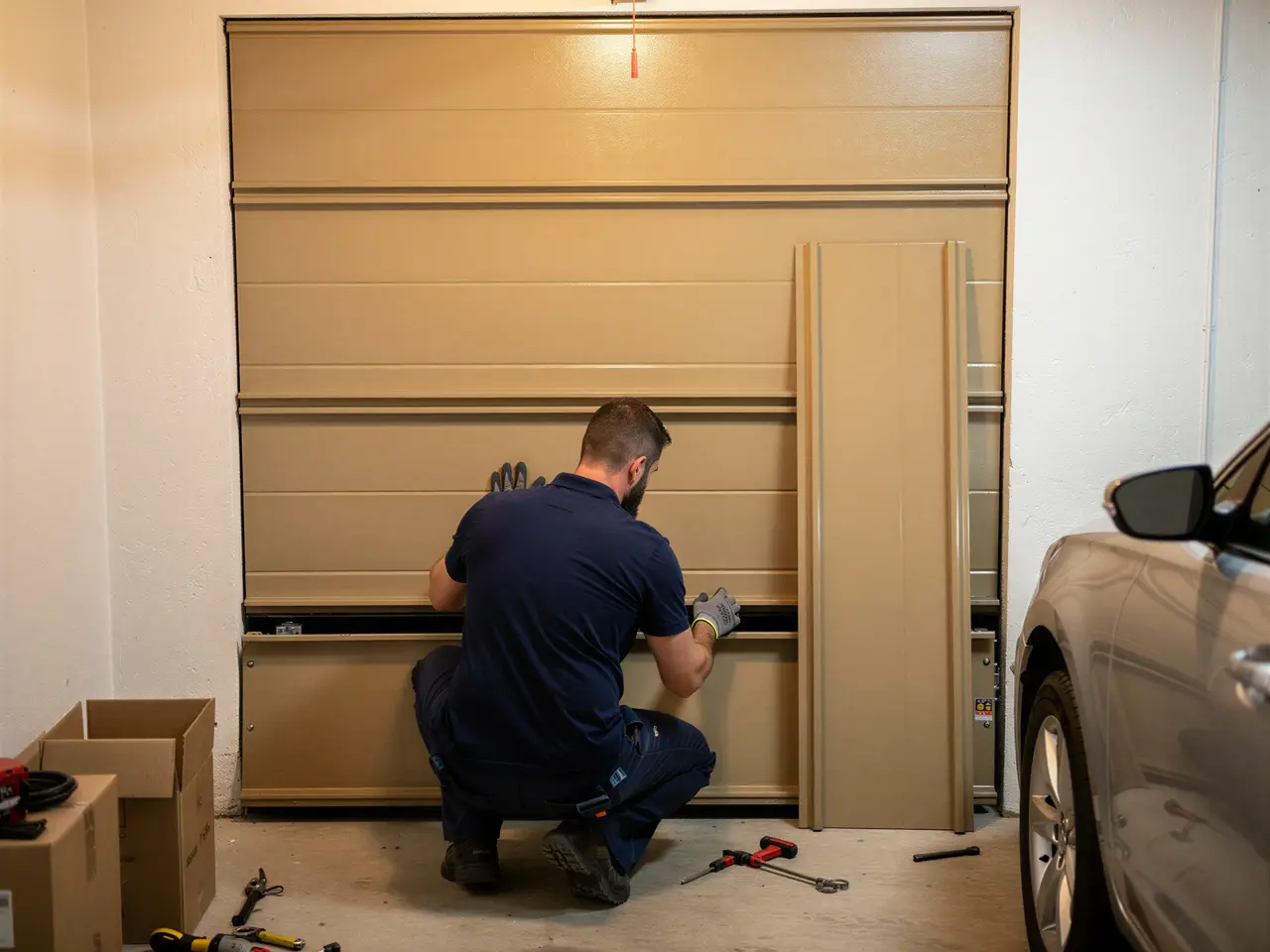
Panel replacement here means matching that older gauge and that older panel height, not just bolting on whatever's in stock. A dented or rusted-through section on a 1970s door often doesn't share a bolt pattern or a panel height with current factory runs, so the first part of the job is identifying what's actually on the track before ordering anything. We pull the damaged section, check the hinges and rollers tied to it for wear, and set the replacement so it tracks true with the rest of the door instead of binding against older, slightly out-of-spec panels next to it.
We travel from Centerville, about 10 miles over, to do this work - there's no branch or depot in Carlisle itself, so scheduling runs through the Centerville shop.
What Is on the Truck
For a door built around the mid-1970s, the truck carries panel stock in the older standard widths and the heavier gauge steel that matched doors of that period, plus the matching end caps and reinforcement struts. Hinges and rollers for that era's track spacing come along too, since replacing one panel often means replacing the hardware bolted straight to it.
We also carry sealant and insulation strip for the seam between old and new sections, because a single swapped panel on an otherwise 45-year-old door rarely matches the weatherstrip profile of the rest of it. Given the cold winters this part of Ohio gets, a poor seal at that seam is where the cold air gets in first.
What we don't carry is custom-cut wood paneling or anything requiring a special order placed before the truck leaves - if the damage calls for a discontinued panel style, that part gets ordered first and the job gets scheduled around its arrival, not worked around on the spot.
Can You Do This Yourself
Swapping a single garage door panel is within reach for someone comfortable with a drill and a ladder, provided the door is unplugged from the opener and properly secured on its track before you start pulling hardware. The panel itself usually isn't the hard part - it's getting the replacement to actually match the hinge spacing and curve of a door built in the 1970s, since current off-the-shelf panels aren't cut to the same dimensions as that era's stock.
Where people get into trouble is the spring tension. If the damaged panel sits anywhere near the bottom of a double-layer door, you're working close to cables and rollers under load, and that's not a place to improvise. If your door is a single panel height from the 9x7 class common in this area, the margin for error is smaller than it looks.
Our honest limitation here: we don't do rush same-day panel matching on doors where the exact discontinued profile has to be sourced first - that part of the job runs on supplier timing, not ours, and we'll tell you up front if a color or panel style needs to be special-ordered before we can finish the job.
Where This Job Goes Sideways
The most common mistake on a door this age is ordering a panel by width and height alone and ignoring the gauge. A 1970s steel door is often a noticeably thinner gauge than anything sold today, and a mismatched panel will sit proud or recessed against its neighbors even if the outer dimensions line up on paper. That shows up as a visible seam line and, worse, as a spot where the door doesn't sit flat against the weatherstrip.
The second place it goes wrong is the hardware carried over from the old panel. Hinges worn from decades of use get reused because they look fine, then the new panel flexes at a joint that's already lost its tolerance. On a door original to a house built around 1977, that hardware has had close to fifty years of cycles on it, and reusing it without inspection just moves the failure point rather than fixing it.
The third is skipping the strut check. A single-layer panel from this era has little stiffness on its own, and without a strut across the new section, wind load on a door this size can bow it within a season.
What Causes It Around Here
The cold winters common to this part of Ohio are hard on doors from the 1970s specifically because that generation of steel is thinner and the seams weren't built with modern weatherstrip tolerances in mind. Repeated freeze-thaw cycling at the bottom panel - where moisture sits longest - is where rust-through damage tends to start on doors this age, and it's the single most common reason we're asked to replace a panel in Carlisle rather than the whole door.
The second driver is just mileage. A door installed when the house was built in the late 1970s has absorbed roughly five decades of opener cycles, accidental bumps from cars and ladders, and minor hail or debris impact, all landing on steel that was never as stiff as what's sold today. One bad impact on an already-thin panel dents it permanently rather than flexing back.
We don't see much storm-driven panel damage here compared to areas closer to open fields - it's steady wear and winter moisture that account for most of the calls.
Frequently asked questions
Will a new panel match the color of my 1970s door exactly?
Not always on the first try. Factory steel finishes and paint formulations have shifted since the 1970s, so an exact color match on an older door sometimes isn't possible off the shelf. We'll show you the closest available option before ordering and flag it if a full repaint is the more realistic fix.
Do you have a branch in Carlisle?
No. We run out of Centerville and travel the roughly 10 miles into Carlisle for jobs here. Scheduling goes through the Centerville shop, same as every other town we cover in the area.
Is it cheaper to replace one panel or the whole door?
Depends on how many panels are damaged and how worn the rest of the door is. On a door original to a house built in the 1970s, replacing one panel can mean fighting a mismatched gauge and finish on an otherwise worn-out door - at that point full replacement is often the better value, and we'll say so plainly.
Can the old hinges and rollers be reused with a new panel?
Sometimes, if they're not visibly worn. But hardware that's been cycling on a door for close to fifty years is usually near the end of its service life even if it looks okay, and reusing it can shift wear onto the new panel instead of fixing the problem.
More garage door services in Carlisle
Book garage door service in Centerville
Call now or request a quote - tell us what the door is doing and where you are.